Cordless Vacuum Buying Guide: Floor Heads, Batteries and Everyday Cleaning
A cordless vacuum should be compared as the machine you will carry, steer, empty, charge and maintain. Suction specifications and maximum battery minutes are useful inputs, but they do not describe that whole routine. A compact apartment with hard floors, a house with deep rugs and a stair-heavy home create different demands on the same design.
Build the shortlist around your actual cleaning route. List the main floor surfaces, the most awkward furniture gaps, the stairs and the small jobs that happen between full cleans. Then compare each candidate with the floor head and power setting appropriate to those tasks. The examples below come from manufacturer documentation; they illustrate how to read specifications rather than present an independent cleaning-performance ranking.
Match the floor head to the work
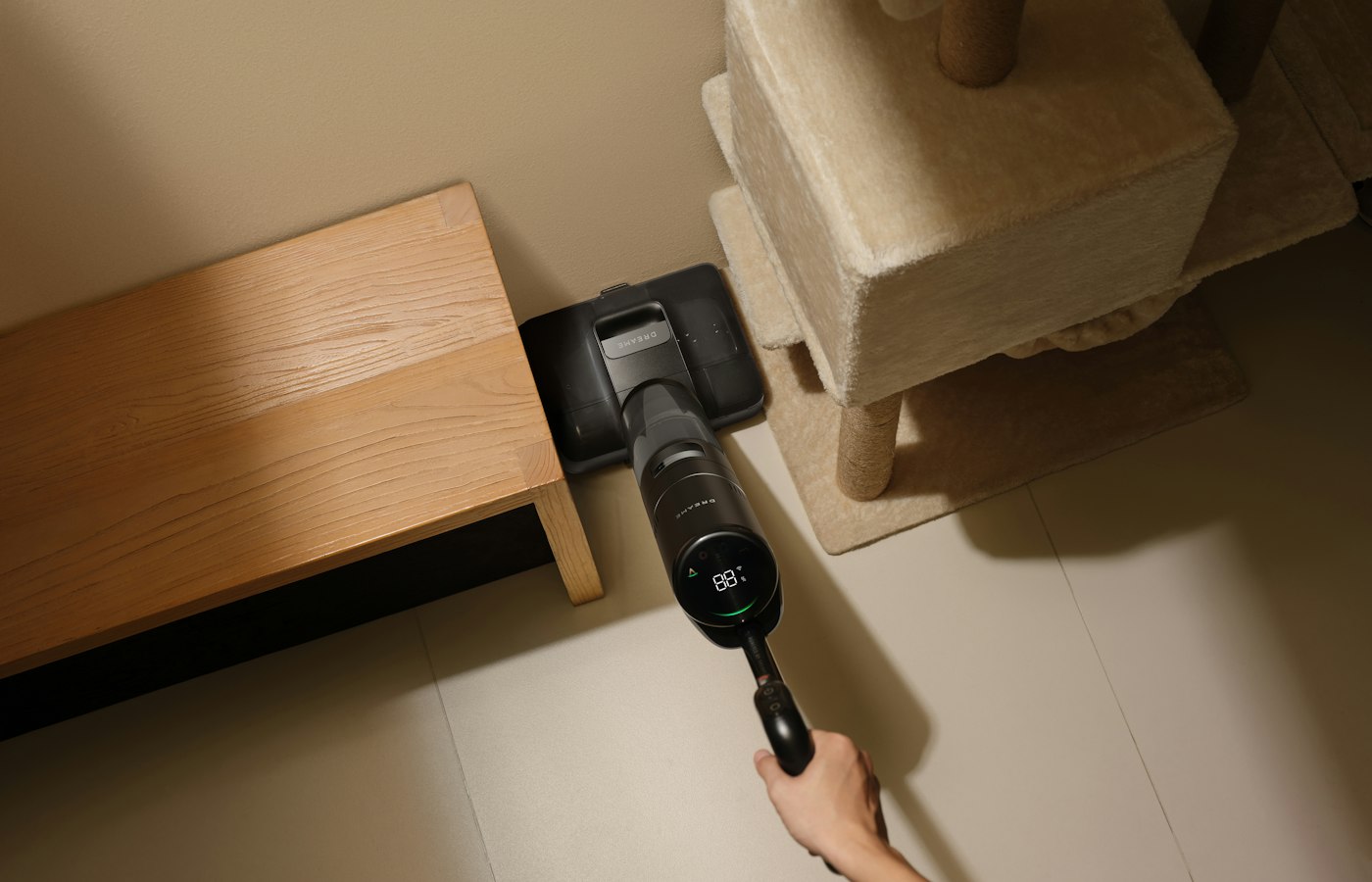
Start by recording the surfaces rather than choosing a brand family. Smooth flooring, a delicate finish, low rugs and thicker carpet need different checks. Confirm suitability against the flooring and vacuum instructions, including restrictions on powered brushes. Also measure the gap under a low cabinet: the height of the head and the position of the motor unit determine access more directly than a photograph of the full appliance.
Dyson’s V15 documentation provides a useful example of why the included head matters. It distinguishes the Fluffy Optic head for hard floors from the Digital Motorbar head for carpets and hard floors. That is more specific information than a general claim that a vacuum works throughout the home. Read the contents of the exact retail package, because accessories can differ between variants.
Treat a motorised upholstery tool, a crevice nozzle and a full floor head as separate tools with separate jobs. A long accessory list is helpful only if it covers your cleaning route. Try converting the machine, reaching a stair corner and removing the tool in a showroom where possible. These small actions reveal whether an attachment is likely to be used regularly.
| Cleaning task | Specification to check | Practical comparison |
|---|---|---|
| Hard floors | Approved head, brush design and floor-care instructions | Check steering, edge access and suitability for your finish |
| Carpet and rugs | Powered-head compatibility and permitted settings | Check push effort and usable runtime in that configuration |
| Stairs | Handheld format and suitable compact tool | Check balance while carrying and changing position |
| Under furniture | Head height and wand articulation | Compare against a measured furniture gap |
| Upholstery and car seats | Included tool and access around seams | Check reach, conversion and how the tool is cleaned |
Put every runtime figure beside its test conditions
A maximum runtime should always travel with its footnote. Shark’s PowerLite BU1621 page, for example, states up to 40 minutes measured in Eco mode at the hand vacuum with a non-motorised tool. That figure should not be relabelled as 40 minutes of powered carpet cleaning. Dyson’s V15 page likewise explains that actual runtime varies with power mode, dust level, floor type and attachments.
Miele’s published Triflex HX2 Sprinter data makes the change in configuration especially clear: it lists 60 minutes on the low setting with the PowerUnit alone, 30 minutes on low with electrical accessories and 14 minutes on high with electrical accessories. These are a manufacturer’s specification examples for that identified model, not measurements made for this guide or a recommendation about current stock.
For your own comparison, record a complete statement: configuration, mode, published duration and charging time. Ask for a powered-floor figure when floors are the main job. If it is not published, leave the field unknown rather than borrowing the handheld maximum.
| Published example | Stated runtime basis | How to use it |
|---|---|---|
| Shark PowerLite BU1621 | Up to 40 min; Eco, hand vacuum, non-motorised tool | Useful for the stated handheld configuration |
| Miele Triflex HX2 Sprinter | 60 min low, PowerUnit solo; 30 min low with electrical accessories | Shows why accessory load must remain visible |
| Miele Triflex HX2 Sprinter | 14 min high with electrical accessories | A separate high-power operating point |
| Dyson V15 Detect range | Up to 60 min; actual runtime varies with mode, dust, floor and tools | Read the qualification before planning a whole-home clean |
Plan the cleaning route before buying another battery
Time a normal clean with the equipment you already use. Separate floor cleaning from furniture, stairs and the pauses spent moving objects. An illustrative route might require 12 minutes in living areas, eight in bedrooms and five on stairs. That is 25 minutes of active work, but it does not establish how long a new machine will run at the necessary settings.
A spare battery can make a stop-and-start routine more flexible when the model supports exchangeable packs. Check how the pack is removed, whether it can charge separately and where both batteries will be kept. A screw-mounted replacement battery and a click-in pack offer different day-to-day convenience. Do not infer compatibility from a similar-looking housing.
Dyson’s replacement-battery guidance directs owners to identify the correct machine and compatible battery. Apply the same exact-model discipline to any brand. Price the appropriate approved battery and charger in your market before assuming a spare makes the system economical. A product page for a part establishes a current procurement route, not a guarantee of supply for every future year.
Compare handling with the machine assembled
Total weight is only one handling question. The position of the motor and battery changes the load you feel at the hand, while the floor head supports part of the assembled machine during floor cleaning. Hold the vacuum in the configuration you will use, then lift it for a higher shelf or a stair. A brief static hold is less informative than the actual movement.
Check the trigger or on-off control, wrist angle, steering around chair legs and how easily the appliance rests while you move furniture. Find out whether it stands independently in the relevant configuration or needs its dock. For a shared home, let the people who will use it check the controls and balance rather than treating one person’s preference as universal.
Charging space deserves the same attention. Measure a proposed wall-dock position and check socket access, tool storage and any installation requirements. A neatly stored machine that is ready for a short clean has a practical advantage that will not appear in a suction comparison.
Account for emptying, filters and brush care
Look closely at how the bin opens and whether debris can be emptied into your household waste container without awkward contact. Check how the brushroll is accessed and which parts the owner is permitted to remove. An anti-tangle feature may reduce one maintenance task; it does not establish that the complete head never needs attention.
Filter care varies by model. Dyson’s V7 Advanced support instructions, for example, require a washed filter to dry completely for at least 24 hours in good airflow before refitting. That is an example of a specific maintenance instruction, not a universal washing rule. Some filters and components must not be washed, so use the manual for the exact appliance.
Create a small ownership record containing filter references, battery reference, cleaning instructions and the regional service route. Ask what is included in warranty cover and what is treated as a consumable. The value of a straightforward maintenance system becomes clearer when you compare the time, drying space and replacement purchases it requires.
Which cordless vacuum is right for your routine?
Do you need the highest advertised suction? First establish the floor task and appropriate head; a single number cannot settle manoeuvrability or the usable battery duration. Is the largest bin always better? Compare how often you would empty it against the size and balance of the assembled machine. Should every home buy two batteries? Only if the cleaning route, exchange procedure and charging arrangement make the extra pack useful.
The strongest shortlist is a record of complete configurations, each able to address your surfaces and maintenance preferences. Keep the floor head, runtime conditions, handling observations, charging plan and replacement route together. Choose the system that fits those needs, then use price and optional conveniences to decide between candidates with an equally clear practical fit.
What to take into your shortlist
Compare cordless vacuums as complete cleaning systems: the right floor head, realistic runtime, comfortable handling and an accessible maintenance route.
- Read runtime figures with their power mode and attachment conditions attached.
- Compare the exact floor heads and accessories included in the local package.
- Check handling, filter care, replacement batteries and charging space before choosing.