Air Purifier Buying Guide: Room Size, Filters and Running Costs
The most useful air purifier is the one that fits the room, the pollutant you want to address and the way you will operate it. A large coverage number is only a starting point. Two machines can advertise the same floor area while assuming very different cleaning rates. A quiet night setting can also move less air than the setting used to establish the headline specification.
Start with a short room record: length, width, ceiling height, adjoining open space and the hours the room is occupied. Then compare the exact model against that record. This guide uses published guidance and specifications to build a practical shortlist. It separates measurable particle delivery from convenience features, so that a screen, app or automatic mode does not become a substitute for the underlying performance information.
Measure the area the purifier will actually serve
A bedroom with a closed door is a different purchasing problem from a living room opening directly into a kitchen and hallway. Measure the connected area you expect the machine to serve, rather than the small patch of floor immediately around it. Note an unusually high ceiling as well. A purifier selected for one room should not be assumed to provide the same result throughout a whole dwelling.
AHAM explains that its suggested room size uses 4.8 air changes per hour. This provides a useful common basis when a manufacturer also lists a much larger area at one air change per hour. Those two coverage figures describe different rates of processing the room volume. Ask which rate supports the advertised area before comparing two packages.
For an illustrative 15-by-20-foot room with an 8-foot ceiling, the volume is 2,400 cubic feet. A particle CADR of 200 cubic feet per minute corresponds arithmetically to five equivalent air changes per hour: 200 multiplied by 60, divided by 2,400. This is a sizing calculation, not a prediction of every particle concentration in an occupied room. It gives you a consistent way to understand the label.
| Room detail | What to record | Why it changes the comparison |
|---|---|---|
| Floor area | Length × width, including connected open areas | Sets the volume the purifier is expected to serve |
| Ceiling height | Actual height rather than an assumed standard | A taller room contains more air at the same floor area |
| Coverage basis | Published air-change rate and test setting | Makes coverage claims comparable |
| Normal use | Occupied hours, open doors and acceptable fan setting | Connects the specification to a realistic operating plan |
Compare particle delivery before filter labels
Clean air delivery rate, or CADR, describes the volume of filtered air delivered for a defined particle challenge. AHAM-certified listings include separate values for smoke, dust and pollen. Keep the units visible: cubic feet per minute and cubic metres per hour are not interchangeable numbers. The AHAM directory lets you check a model by its certified ratings and suggested room size instead of relying only on a retailer summary.
A filter-efficiency label describes one part of the system. Your comparison also needs the amount of air passing through it. Read the complete product specification, and look for information about the operating speed associated with the published delivery figure. If a bedroom purchase depends on low-speed operation, ask for the airflow or CADR available at that speed rather than assigning the maximum figure to every mode.
Separate particle filtration from gas and odour claims
The US Environmental Protection Agency distinguishes particle filtration from gas removal. CADR is a particle rating; it does not establish how effectively a unit removes every gas or smell. For gases, EPA points to activated carbon or another suitable adsorbent material and notes that the amount of material matters. A thin dark layer in a filter photograph does not, by itself, tell you the useful capacity or service life.
Write down the actual concern before choosing a feature. Airborne dust calls for a particle comparison. An odour claim needs different supporting information. If a product combines several technologies, find the explanation for each one and the replacement part required to maintain it. Filtration also complements source control and appropriate ventilation; it does not remove every pollutant from a home.
California Air Resources Board guidance is useful when checking electronic air-cleaning features and ozone. Follow the instructions for the exact device, and avoid treating an ozone-related certification as a measurement of particle-cleaning performance. Keep safety compliance, particle delivery and gas-filter capability as separate entries on the comparison sheet.
Choose a fan setting that fits the room
For a living room, imagine watching a quiet programme while the purifier runs. For a bedroom, consider indicator lights, a display that can be dimmed and the sound of a speed change during the night. A machine that fits the floor plan but is regularly switched off does not follow the operating plan you used to justify the purchase.
Compare published sound levels with their fan settings and measurement conditions attached. A minimum-noise number and a maximum-delivery number may describe different modes. Automatic operation can be convenient, but a display colour is not a complete account of indoor air quality. Read which sensor is fitted, what it measures and how the machine responds.
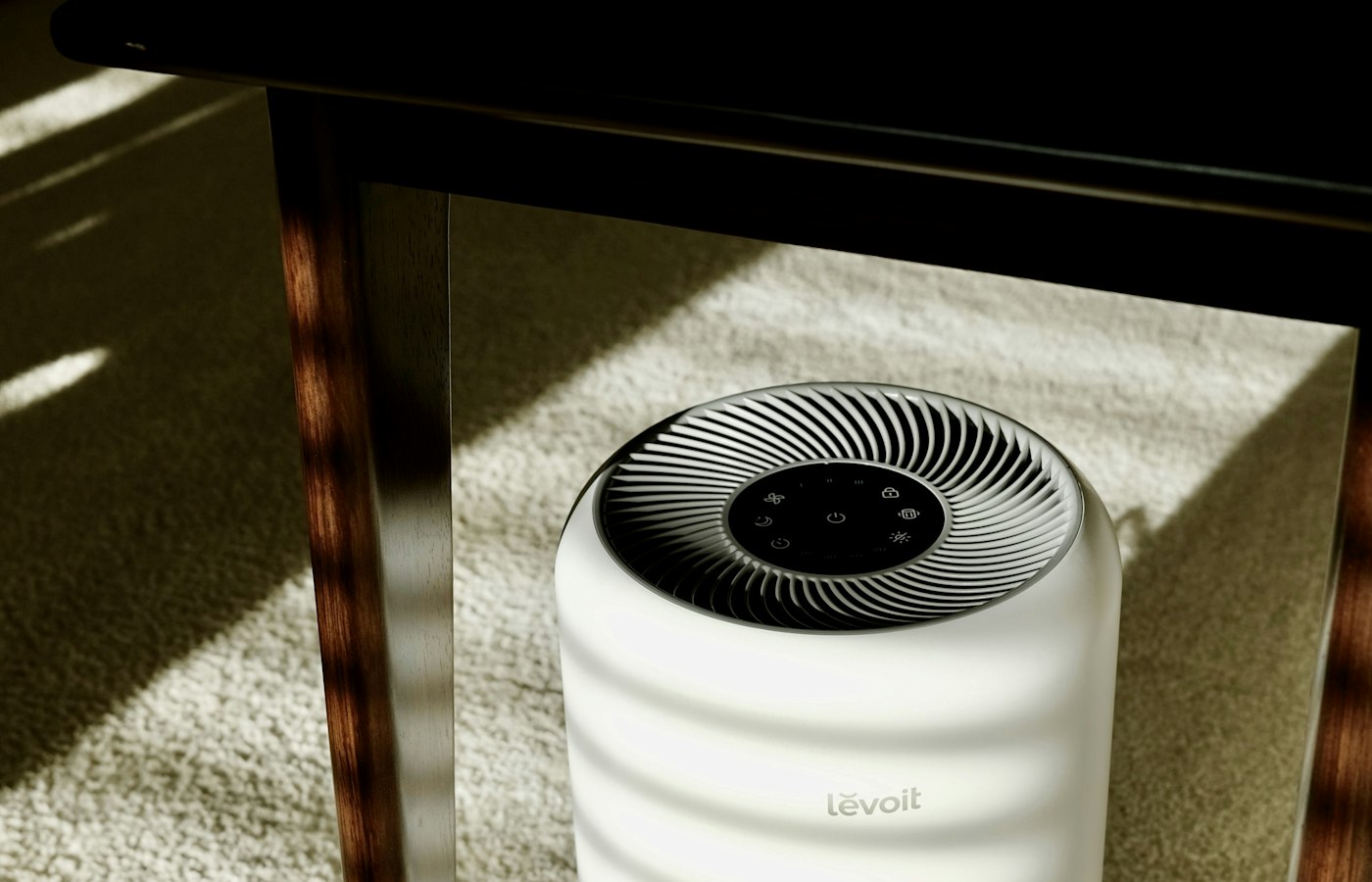
Plan the position before ordering. ENERGY STAR recommends following the manual and keeping airflow unobstructed. Check the specified clearance, access to the filter cover, the nearest socket and whether curtains or furniture could block an inlet. This simple placement check can settle a shortlist more decisively than another decorative feature.
Calculate ownership cost using your own assumptions
The filter is an ongoing purchase. Record its exact part number, the manufacturer’s replacement guidance and how it is obtained in your region. Check whether a pre-filter can be cleaned and which elements must be replaced. A reminder light may measure elapsed use rather than directly measure all remaining filter capacity, so read the manual before using it to forecast annual spending.
Electricity is easier to compare when the operating assumptions are explicit. In a hypothetical example, a purifier drawing 35 watts for 12 hours per day uses about 153.3 kilowatt-hours per year: 35 divided by 1,000, multiplied by 12 and 365. At an illustrative electricity rate of $0.20 per kilowatt-hour, that is $30.66. Substitute your tariff, hours and the power draw at the chosen mode; a maximum nameplate rating may not represent everyday consumption.
ENERGY STAR’s air-cleaner guidance and product finder provide an additional efficiency check. Compare the exact certified model, then add your local filter price and anticipated replacement frequency. Keep the initial purchase price, electricity and consumables in separate columns so that a low entry price does not hide the ownership pattern.
Which questions should decide the final shortlist?
Can one larger purifier serve two bedrooms? Treat separated rooms as separate airflow problems; a larger advertised area does not guarantee useful circulation through doorways. Can a purifier remove every cooking smell? Ask for gas-filter evidence and address the source rather than using particle CADR as proof. Is a washable filter automatically cheaper? Price the complete filter assembly and follow its specific cleaning instructions.
Before purchase, your record should contain a measured room, a comparable CADR or coverage basis, a tolerable operating setting, the correct filter reference and an annual cost scenario. Choose the model with the clearest fit across those requirements. Features such as scheduling, a child lock or an app can then settle a close comparison, after the cleaning and ownership questions have been answered.
What to take into your shortlist
Compare air purifiers through verified room coverage, particle delivery, filter replacement and the cost of the setting you will actually use.
- Compare room-size claims at the same air-change rate and ceiling height.
- Use particle CADR to compare particle cleaning, then check gas-filter evidence separately.
- Budget for replacement filters and electricity at a fan setting you can comfortably keep running.